

The ‘Randomness’ of the Grand Swiss
It’s always a topic of debate: how can FIDE improve Candidates, and ultimately World Championship, qualification?
The current system offers one spot each to the 2024 and 2025 FIDE Circuit winners, as top performers of each year’s batch of tournaments; two spots for the top two finishers at the Grand Swiss; three spots for the top three finishers at the World Cup, in November this year; and one final spot for the player with the highest average rating in the months before the Candidate tournament.
Of course the rating qualifier has had the most contention and controversy (Alireza Firouzja, Ding Liren, and Hikaru Nakamura all having played games in less than conventional fashion), though there are arguments to be made about the ‘single performance’ qualifiers. We will leave the question for the World Cup at, how sensible is it to have the semifinal losers play an extra match to earn a place, rather than an alternative method of deciding a perhaps worthier eighth qualifier?
The Grand Swiss questions are deeper, and revolve around the idea of randomness — factors outside of a player’s control influencing the result of the tournament. One of the reasons chess is so loved is that what happens on the board is up to the player, but on a higher plane there are indeed random factors in chess, even beyond what will be discussed here.
On a surface level, you mileage may vary on whether 8 players being able to qualify for the Candidates heading into the final round is reasonable or not. On one hand, it makes for excellent theater; on the other, the way the tiebreaks were set resembles a Titled Tuesday more than a marquee event.
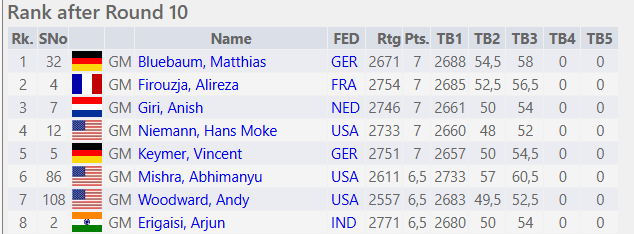
Results far down the standings can have an impact on the contenders’ mathematical tiebreaks, which seems very strange. To that there is a possible fix: that this tournament, more than others, should be determined by playoff games, seeing as it is such a monumental event. The players’ fates should be in their own hands and minds, and not the result on the 24th board.
That doesn’t quite cover it, though. 11 rounds means half the players will have 6 Whites and 5 Blacks, and the other half will have 5 Whites and 6 Blacks. How much of a difference do you think that extra White game makes? Chess performance coach Benjamin Portheault contributed a chart on the topic.
Of the players in an 11-round swiss to score 7/11 or better, 70% have come from the group with an extra White game. In this year’s Grand Swiss, it was even a little higher, at 79%. Thus, if a player happens to be given a sixth Black, they are behind the 8-ball. The reason chess tournaments are played with an odd number of rounds is that otherwise it is fully possible for someone in a standard swiss to be given two extra Whites or Blacks instead of one, but this seems to be a more important discrepancy to account for.
There may not be a perfect solution, to this or to the Candidates as a whole; one might prefer the variety of the existing system over the directness of holding eight individual qualifying tournaments. But there are improvements, which means we will all keep talking about it every time another event is played.

