



How many knights?
Here is an odd question: how many knights can you place on a chess board, such that no two knights are attacking (protecting) each other? Pause if you would like to consider, then see the diagrams below.
.
.
.
Here’s an example of 24 knights:

Not bad, but it feels like we can do better with the space. The best arrangement is 32 knights.
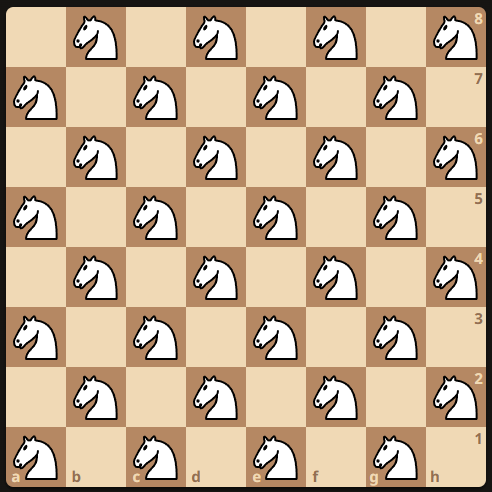
We could choose the light squares with the same effect. To verify this works, we might check for every knight, one by one. Easier is knowing that a knight on a dark square only attacks light squares, so if there are only knights on dark squares, none can be attacking each other. If there’s anything useful from this exercise, it’s that knights only attack the other colour of square!
Proving there can’t be more than 32 is trickier to do formally, but we’ll give it a go. To have a 33rd knight, at least one must be on a light square. But notice that every light square is attacked by at least two knights. Thus, you would have to remove at least two knights on dark squares to add a new knight on a light square. Further, recognize that the most efficient placement in any given 3×3 square is 5 knights, either in a ‘+’ or an ‘X’ shape. The ‘+’ prohibits the use of any adjacent square to the 3×3 block – the knight in the centre is most responsible – while the ‘X’ knights are all on the same colour, and rule out the use of any adjacent square of the opposite colour. Then we would not be able to squeeze in any extra knights to make up for the loss at the beginning, because we either copy the existing 32-knight pattern, or exclude too many squares.
So, 32 is the best we can do!

