



What Are Chess Coordinates and Notations?
Do you ever hear professional chess players rapping out “d4 d5 Nf3 Nf6 c4 dxc e3” and find yourself in nothing but utter confusion? Well, not anymore!
As you advance from beginner to intermediate levels of chess, the language of the game and its moves make their way into your vocabulary. Follow this easy step-by-step guide to master the art of notations.
NAMING THE 64 SQUARES
The 8×8 chessboard is composed of 8 rows, also known as Ranks (1 to 8), and 8 columns, referred to as Files (a-h). The first row from the white side is designated the “1st” rank, while the first column from the left is named as the “a” file.

A square is named by putting together the File and the Rank is falls with the syntax, XY, where
- X = File (anything from a to h)
- Y = Rank (anything from 1 to 8)

Now that we know what the squares are called, let’s see how we write notations for the moves!
How to Read Notations?
Each piece in chess, except the pawn, is given an alphabet from Roman script, which is used to describe that piece:
- K = King
- Q = Queen
- R = Rook
- B = Bishop
- N = Knight
So if we are to move a Knight to the square f3, the notation goes – Nf3. As for the pawn moves, one just writes the square name the pawn is moving to, for instance, e4.
SPECIAL CASE I
In case there are multiple pieces (on different files) that can access that square, we write the notation as – N(Current file)f3. For example:

SPECIAL CASE II
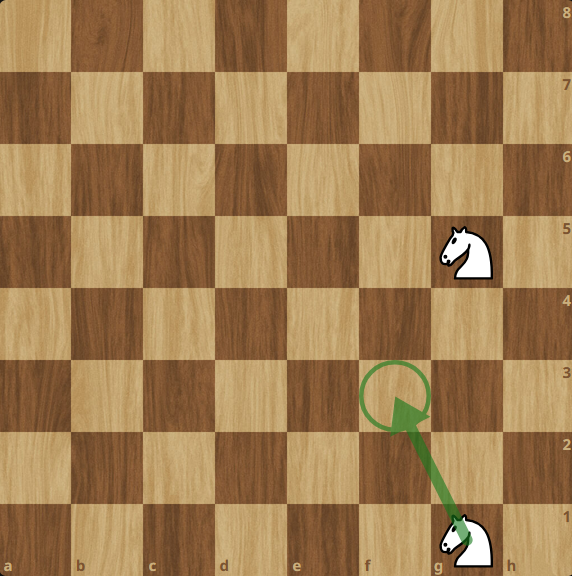
In case there are multiple pieces (on the same file) that can access the square, we write the notation as – N(current rank of the piece)f3. For example:
CHECKS, CAPTURES, MATE, CASTLING AND PAWN PROMOTION
- CHECKS – The suffix ‘+’ is added to the moves which give a check to the king. Example: Ng4+
- MATE – The suffix ‘#’ is added to the moves which deliver the checkmate to the opponent’s king. Example: Qf7#
- CASTLING – The notation for short castling is written as “O-O”, while for queenside castling, it is written as “O-O-O”.
- CAPTURES – An ‘x’ is added before the square name on which the capture is being made. Example: Nxg4 suggests that a piece was captured by the knight on the square g4.
- Pawn Captures (Exception): For pawn captures, we replace the piece symbol with the file name of the pawn. Example: axb4 suggests that a pawn on the a-file captured a piece on the square b4. In case of pawn-to-pawn captures, we might just suffice with axb (without the compulsion of mentioning the full coordinates).
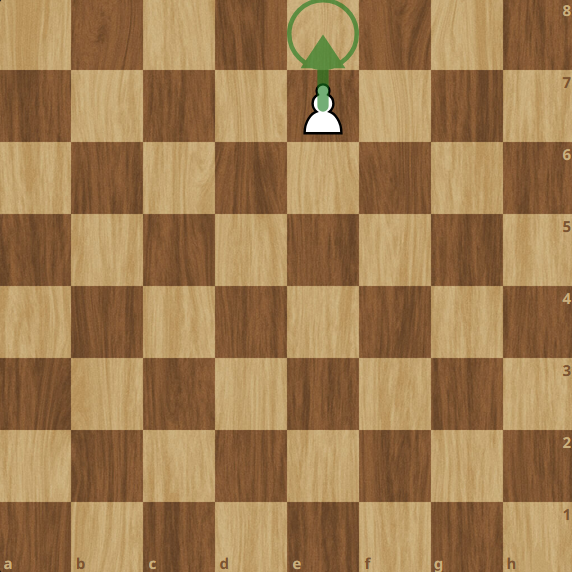
- Pawn Promotion – A pawn move which lands a pawn on either the 1st or the 8th rank allows it to be promoted to any other piece in the game (except the king), for which the notation is written as (pawn move)=(symbol of the piece promoting to), for example:
Now you’re fluent in the language of chess notations and coordinates! Follow Chess Ninja for more such educational pieces and exciting stories around the chess world.

